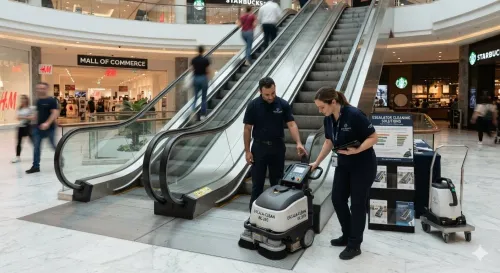
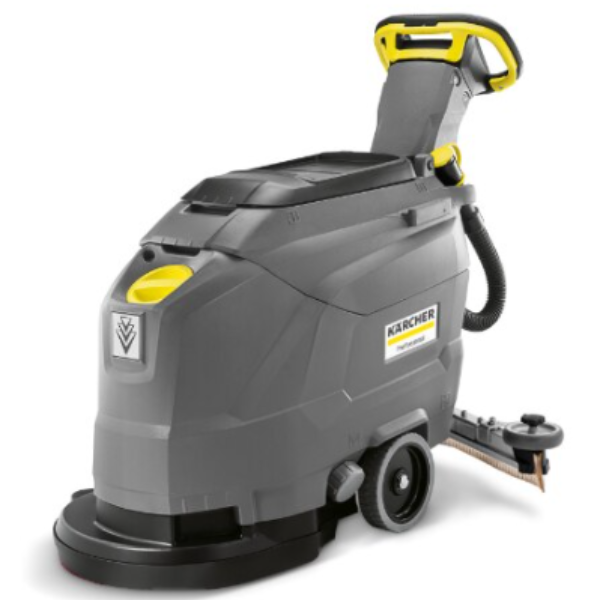
Large industrial floors can consume significant labour when cleaning depends primarily on manual mopping. A Walk-Behind Scrubber Drier mechanises key parts of the floor-cleaning process, making it relevant for factories, warehouses, workshops, commercial premises, plus facility-management operations.
For businesses in Nashik, Maharashtra, the main purchasing question is whether the machine matches the floor area, layout, contamination level, plus available cleaning window.
Understand the Cleaning Process
A scrubber drier applies cleaning solution to the floor, agitates the surface using a cleaning mechanism, then collects dirty water.
This allows cleaning plus water recovery to take place within the same operating process.
Compared with conventional manual methods, mechanised cleaning can help teams cover larger areas more systematically while reducing the amount of residual water left on suitable floors.
Measure the Actual Cleanable Area
Total building area is not the same as cleanable floor area.
A factory may contain machinery, storage racks, workstations, columns, production lines, plus restricted zones. These obstacles reduce the open floor area accessible to cleaning equipment.
Before selecting a machine, assess:
- Open floor area
- Aisle width
- Doorway width
- Turning space
- Congested sections
- Floor condition
- Cleaning frequency
- Available cleaning time
These details help determine suitable machine dimensions plus working width.
Match the Machine to the Layout
Walk-behind equipment can be particularly useful where operators need manoeuvrability around aisles, equipment, plus facility obstacles.
A wider cleaning path can improve theoretical productivity, but an excessively large machine may become difficult to manoeuvre within narrow sections.
This is why practical layout assessment is more useful than choosing the largest available model.
Consider Tank Capacity
Clean-water plus recovery-tank capacity affects how frequently operators need to stop for refilling or emptying.
Larger tanks can reduce interruptions across bigger areas, but they can also affect machine dimensions plus handling.
Facilities should balance capacity with manoeuvrability according to the cleaning environment.
Floor Type Matters
Different floors may require different cleaning pads, brushes, pressure settings, plus cleaning chemicals.
Industrial concrete, epoxy-coated floors, tiles, plus other surfaces should be assessed before establishing the cleaning method.
The objective is effective soil removal without unnecessarily damaging the floor finish.
Evaluate Battery Requirements
For battery-operated equipment, runtime should be compared with the facility's cleaning schedule.
If a machine cannot complete the planned area within the available charge, cleaning productivity may suffer.
Businesses should consider:
- Expected runtime
- Charging duration
- Battery maintenance
- Charging location
- Shift schedule
- Daily cleaning area
Battery planning is particularly important when the machine is expected to operate every day.
Consider Operator Comfort
Floor-cleaning productivity depends partly on the operator.
Controls should be understandable, routine tasks should be manageable, plus the machine should be reasonably easy to manoeuvre within the intended environment.
Training operators in correct chemical dosage, brush selection, water management, battery care, plus daily cleaning of the machine can also improve performance.
Sahas Utility Services supports industrial cleaning equipment requirements for businesses across Nashik.
A walk-behind scrubber drier is most useful when it is matched to the facility rather than selected only by headline productivity figures. Floor area, obstacles, working width, tank capacity, battery runtime, surface type, plus cleaning schedules all influence whether the machine can deliver practical productivity in everyday facility maintenance.
Keywords